Ignition SCADA vs. Wonderware ArchestrA: Which Should You Learn?
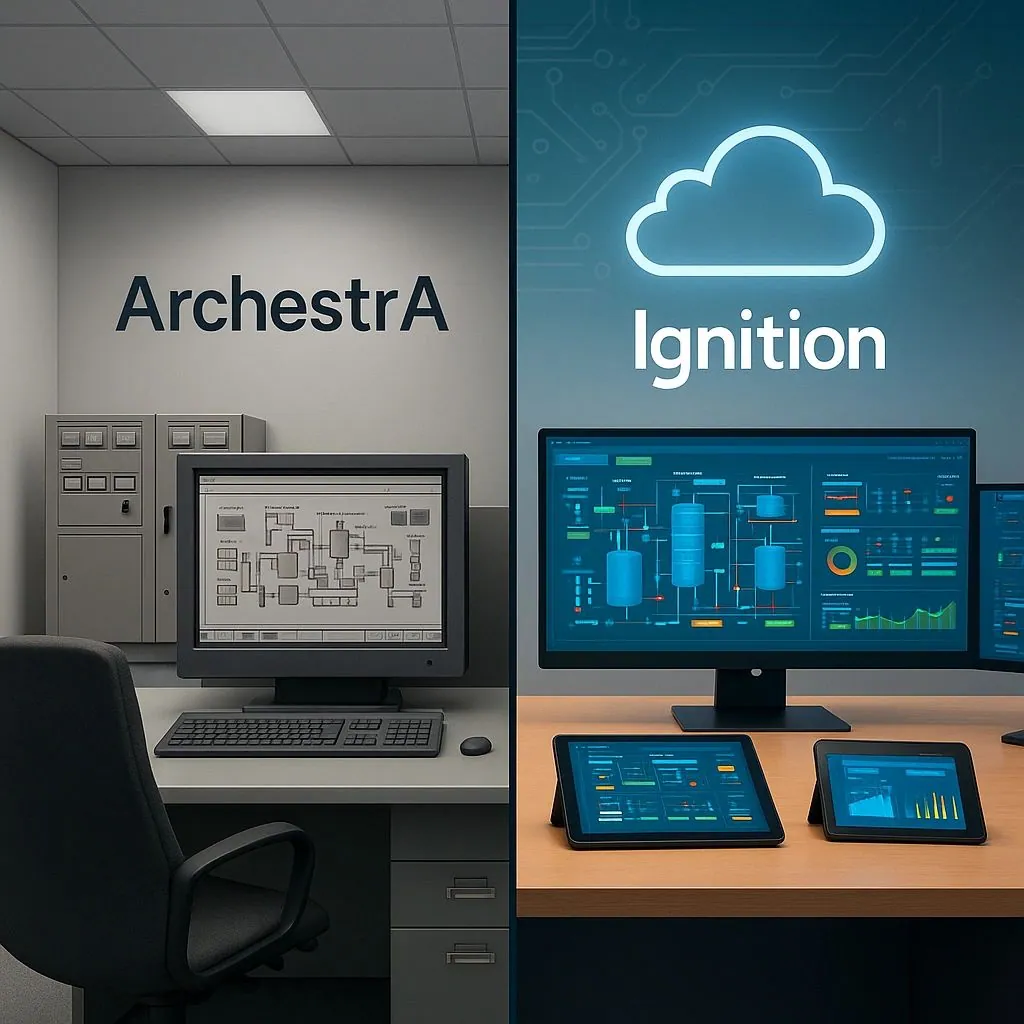
Introduction: The Changing Landscape of SCADA
In the fast-paced world of industrial automation, Supervisory Control and Data Acquisition (SCADA) platforms are the backbone of real-time control, visualization, and data acquisition. Two of the most prominent SCADA systems on the market today are Ignition by Inductive Automation and Wonderware ArchestrA System Platform, now branded under AVEVA. As organizations modernize and digitize their operations, professionals and students alike are asking: Which SCADA platform should I learn to build a sustainable and future-proof career?
The answer depends on your career goals, industry sector, and whether you’re focusing on legacy system support or future-ready development. This study explores a head-to-head comparison across architecture, usability, licensing, industry relevance, and learning curve to help you make an informed decision.
Platform Architecture and Philosophy
Wonderware ArchestrA was a groundbreaking innovation when it debuted in the early 2000s. Designed around a layered object-oriented architecture, ArchestrA introduced the idea of industrial application templates, enabling reuse, standardization, and centralized management. Built on top of Microsoft’s .NET and DCOM frameworks, it integrates tightly with Windows environments. It remains popular in large, hierarchical organizations with long upgrade cycles, especially in oil & gas, energy, and pharma sectors.
Ignition, by contrast, is a modern, modular platform built on Java and designed to be cross-platform, web-based, and scalable from edge devices to enterprise architectures. It runs as a central gateway and offers HMI/SCADA, IIoT, historian, MES, and reporting in a single install. Its modularity, openness, and MQTT support make it the platform of choice for digital transformation and Industry 4.0 initiatives.
Summary:
- ArchestrA: Legacy-aligned, Microsoft-centric, layered architecture.
- Ignition: Web-native, modular, modern, Java-based.
- Verdict: Ignition wins in future-readiness and flexibility.
Development Environment and User Experience
ArchestrA System Platform development typically requires multiple components: the Integrated Development Environment (IDE) or the Integrated Galaxy, InTouch for visualization, and various configuration tools for alarms, historians, and object templates. Deployment and management can be complex and require high technical overhead. Version control and multi-developer collaboration have improved but are still rigid.
Ignition Designer, in contrast, is a unified development environment. All configurations, from HMIs to scripting and alarm pipelines, are handled in a single interface. It supports real-time collaboration: multiple developers can work on the same project simultaneously without conflict. Ignition also provides hot deployment, allowing you to update live systems without downtime.
Summary:
- ArchestrA: Multiple tools, steeper learning curve, but powerful object inheritance.
- Ignition: Unified, intuitive IDE with modern workflows.
- Verdict: Ignition offers a smoother, more modern development experience.
Licensing and Cost Model
Wonderware ArchestrA, now AVEVA System Platform, has historically followed a traditional perpetual licensing model—charging based on tag counts, client sessions, and individual modules. However, in recent years, AVEVA has moved away from perpetual licenses, pushing customers toward flexible subscription-based models. While this aligns with broader industry trends, it has introduced new complexities and ongoing costs that many users did not previously face. For large enterprises with mature budgeting structures, this shift is manageable. But for integrators, OEMs, and operations teams planning future system rollouts, the change has prompted serious reconsideration of long-term strategy.
Ignition, by contrast, continues to offer a single, unlimited license model that is predictable, transparent, and highly scalable. A one-time gateway license includes unlimited tags, clients, and screens—you only pay for feature modules such as Vision, Perspective, MQTT Transmission, or SQL Bridge. This pricing model dramatically reduces procurement friction and future expansion costs. As a result, many Tier 1 companies are standardizing on Ignition for future deployments, citing cost predictability, openness, and cloud readiness as key factors.
Summary:
- ArchestrA (AVEVA): Now subscription-based, increasing total cost of ownership and complexity.
- Ignition: Unlimited licensing, simple cost model, scalable for all sizes.
Verdict: Ignition continues to lead the market in cost transparency and scalability, prompting many major enterprises to adopt it as their new platform standard.
Industry Adoption and Job Market
ArchestrA remains dominant in heavily regulated and legacy-dominated industries, including large utilities, pharma, and energy companies. If you plan to work for these companies or support legacy infrastructure, ArchestrA expertise remains highly valuable. Certifications like Certified ArchestrA Developer are still in demand.
Ignition is quickly gaining traction in mid-sized manufacturers, system integrators, IIoT vendors, and forward-thinking enterprises seeking cloud integration, centralized management, and mobile-friendly interfaces. Many companies are replacing legacy systems with Ignition or augmenting existing platforms using MQTT and edge gateways.
Indeed and LinkedIn Trends (as of mid-2025):
- Ignition-related jobs have increased by over 40% in the past 18 months.
- ArchestrA demand remains steady but concentrated in fewer companies.
- Ignition developers often enjoy higher mobility due to its modern architecture and cloud readiness.
Summary:
- ArchestrA: Stable in legacy enterprises, limited mobility.
- Ignition: High-growth market, adaptable skillset.
- Verdict: Ignition offers broader future opportunity.
Training, Certification, and Community Support
ArchestrA/AVEVA offers structured training programs through AVEVA Partner Network and authorized distributors. Certification is valuable but costly. Community support is more traditional—relying on vendor forums, distributor relationships, and internal company documentation.
Ignition offers Ignition University—a completely free, self-paced training platform leading to Core and Gold certifications. These credentials are recognized by integrators and employers globally. The community is highly active, with a public forum, shared scripts, and free modules.
Summary:
- ArchestrA: Formal training, paywalled certification.
- Ignition: Free, accessible, community-driven learning.
- Verdict: Ignition is easier and more affordable to learn.
Technical Capabilities and Extensibility
ArchestrA features robust template-driven design, high-performance HMI graphics, historian integration (Historian & Insight), and enterprise-grade alarm/event handling. However, scripting is VBScript or .NET-based, limiting flexibility in some cases. Mobile access and cloud integration are possible but often require additional licensing or engineering effort.
Ignition excels with Python scripting (Jython), tag-based architecture, MQTT Sparkplug B integration, and full SQL-based historian support. It also offers REST APIs, webhooks, and integration with cloud services (AWS, Azure, Google Cloud). Vision (traditional HMI) and Perspective (mobile-first HMI) offer flexibility across platforms.
Summary:
- ArchestrA: Mature features, limited openness.
- Ignition: Cloud-native, extensible, modern scripting.
- Verdict: Ignition leads in extensibility and cloud readiness.
Free Download and 2-Hour Full Runtime: Training and POC Made Easy
One of the most compelling advantages of Ignition by Inductive Automation is its free download and unlimited two-hour trial mode. Anyone—from engineers and developers to students and plant managers—can download the full Ignition platform from Inductive Automation’s website and use all its features without limitations for up to two hours per session. After two hours, the software simply requires a reset to continue.
This functionality has profound implications:
- Training and Learning: New users can explore Ignition’s Vision, Perspective, scripting, database connectivity, and alarming modules at their own pace—no licensing required. This democratizes access to high-end SCADA training without upfront costs.
- Proof of Concept (POC): System integrators can develop fully functional demos or pilot applications in a real-world environment without needing to purchase a license first. This lowers the barrier to entry and accelerates the decision-making process for clients.
- Rapid Prototyping: Engineers can build, test, and refine applications locally or in virtual machines before deploying to production. All features are unlocked—including tag simulation, historian, MQTT modules, and scripting—making this an invaluable tool for agile development.
By contrast, Wonderware ArchestrA / AVEVA System Platform does not offer a free, fully functional runtime environment. Training requires licensed environments, and developing a POC usually necessitates a trial license issued through a distributor—a process that can take time and impose limitations.
Verdict: Ignition’s free 2-hour trial mode is a game-changer. It promotes accessibility, encourages experimentation, and accelerates skill development, making it one of the most training- and integrator-friendly platforms in the industry.
Use Case Scenarios: Which Platform Fits Best?
You Should Learn ArchestrA If:
- You work in an enterprise already using System Platform.
- Your role involves maintaining legacy SCADA systems in oil & gas, utilities, or pharma.
- You prefer or are required to use Microsoft-centric systems.
- You’re supporting InTouch and Galaxy infrastructure in plants with long deployment cycles.
You Should Learn Ignition If:
- You are entering the industry and want a future-proof skillset.
- Your work involves edge devices, MQTT, or cloud-based architectures.
- You are building modern control rooms with mobile and web access.
- You want to prototype, test, and deploy solutions rapidly without high upfront licensing costs.
Final Considerations
There is no single "best" SCADA system—context matters. ArchestrA remains a stronghold in traditional industrial automation environments, especially where validation, long service cycles, and vendor loyalty prevail. Its template object model is powerful when leveraged by experienced engineers.
Ignition, however, represents the new wave of SCADA—open, rapid, scalable, and aligned with modern IT practices. It speaks the language of integration, modularity, and flexibility. For automation professionals wanting to stay competitive over the next 10–20 years, Ignition is a must-learn platform.
For maximum value, automation professionals should ideally learn both platforms—ArchestrA for maintaining legacy systems and Ignition for building the future. However, if you're starting from scratch or pivoting mid-career, Ignition offers a lower barrier to entry, faster time to competence, and better alignment with the direction of the industry.
Next Steps
- Begin with the free Ignition University.
- Consider the Core Certification Exam to validate your skills.
- For ArchestrA, seek authorized AVEVA training partners in your region or employer-sponsored programs.
- Visit LearnSCADA.com for free Ignition and SCADA training resources.
Charles Vance is a senior automation consultant with over 30 years of experience in SCADA and industrial control systems. He is Ignition Core Certified, Ignition Gold Certified, and a Certified ArchestrA Developer, specializing in HMI/SCADA modernization, control room architecture, and digital transformation across critical infrastructure sectors.
Get new LearnSCADA articles
New articles on SCADA, Ignition, alarm management, and industrial data, by email. No spam. Unsubscribe any time.
Comments
No comments yet. Start the conversation.