Data and Digital Transformation
Understanding Modbus is now a course, and the book comes with it
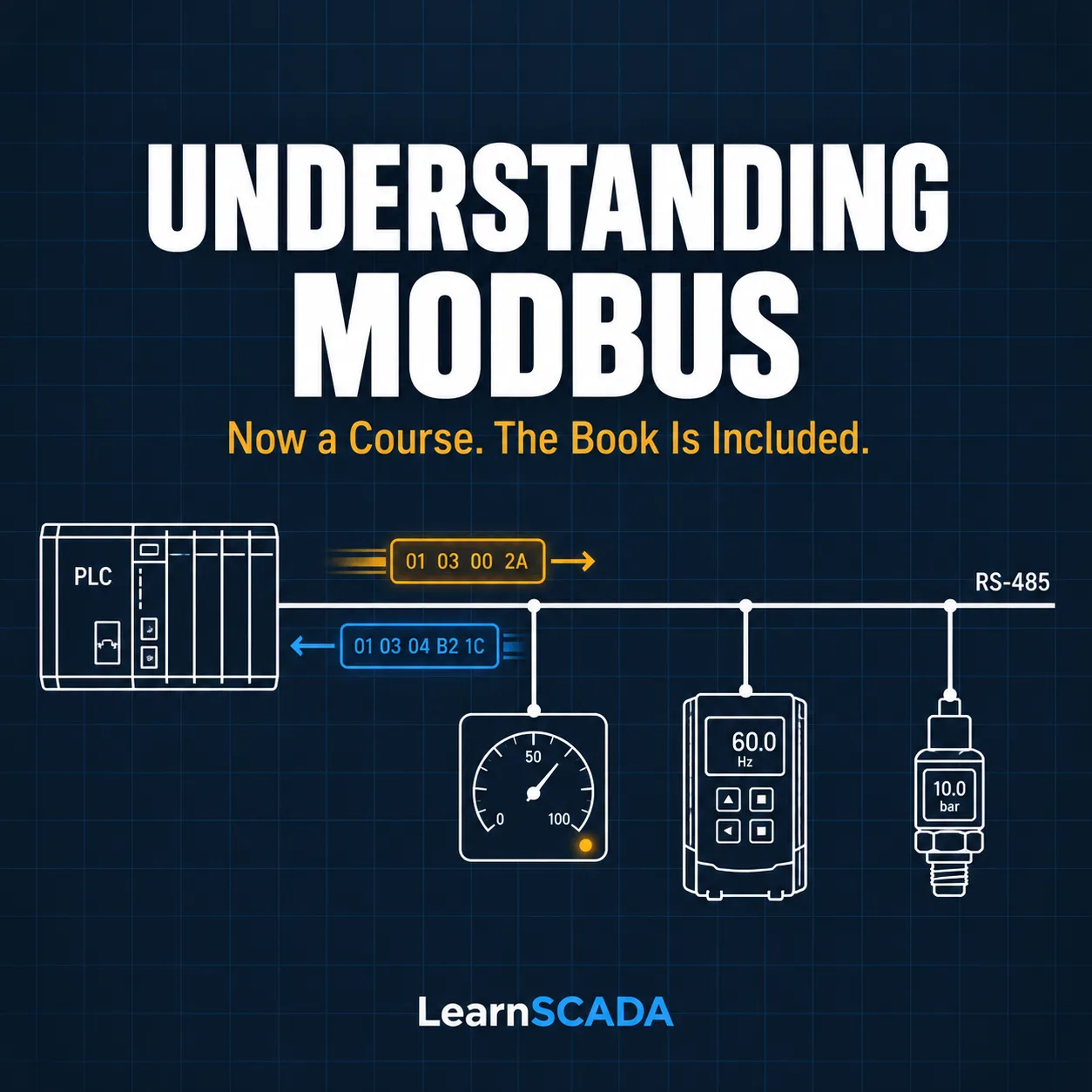
Every chapter of the book, rebuilt so you can watch the bytes move, change them yourself, and check what you learned before moving on.
Request
Response
One complete Modbus RTU poll. The client asks server 1 for holding register 42, and the meter answers with 245. In the course, figures like this one step forward and back one byte at a time, and the CRC is calculated live as you change the frame.
Why Modbus, and why now
Modbus is older than most of the people who troubleshoot it, and it is still the common language of meters, drives, PLCs, and SCADA systems. Almost every plant has it somewhere, usually on the device nobody wants to touch. When it works, nobody thinks about it. When it stops, the person who can read the bytes on the wire is the person who gets the plant running again.
The book Understanding Modbus was written to make that person you. The course takes the same material and puts it in motion.
What the course is
The course follows the book chapter by chapter, all 19 of them. Each chapter has three parts:
- Animated figures you can play, pause, and step through, so you see each idea happen on the wire instead of picturing it from a diagram.
- Hands-on tools that run right in your browser. You change the frame, the address, or the data type and see the result immediately. There is nothing to install.
- A short check at the end, so you know the chapter landed before you move on.
What you will be able to do
- Build RTU, ASCII, and TCP frames byte by byte, with the CRC and LRC calculated live.
- Decode registers the way real devices send them, including signed values, scaling, 32-bit integers, floats, and word order.
- Run the pump-station monitoring project in your browser first, then build it for real in Python.
- Troubleshoot with the three outcomes every Modbus request ends in: data, an exception, or silence. Knowing which one you got tells you where to look.
- Write working Python and pymodbus code for a Raspberry Pi or any Linux machine.
The complete book is included
Understanding Modbus
A Practical Guide to the Protocol, with Hands-On Microcomputer Examples. By Charles Vance.
Enrolling in the course gives you the full book as a PDF download, right from the course page. Read ahead, keep it open beside the lessons, or keep it on the bench for the day a device stops answering. The course and the book cover the same chapters in the same order, so you can move between them without losing your place.
Try it before you enroll
Part I is free to preview. Work through the opening chapters, run the animated figures, and try the tools. If the format works for you, enroll for the rest of the course and the book.
The course runs on the LearnSCADA store at books.learnscada.com. Sign in with your store account, or create one when you start.
Get new LearnSCADA articles
New articles on SCADA, Ignition, alarm management, and industrial data, by email. No spam. Unsubscribe any time.
Comments
No comments yet. Start the conversation.